
Crypto taxes in Belgium: when to declare your gains
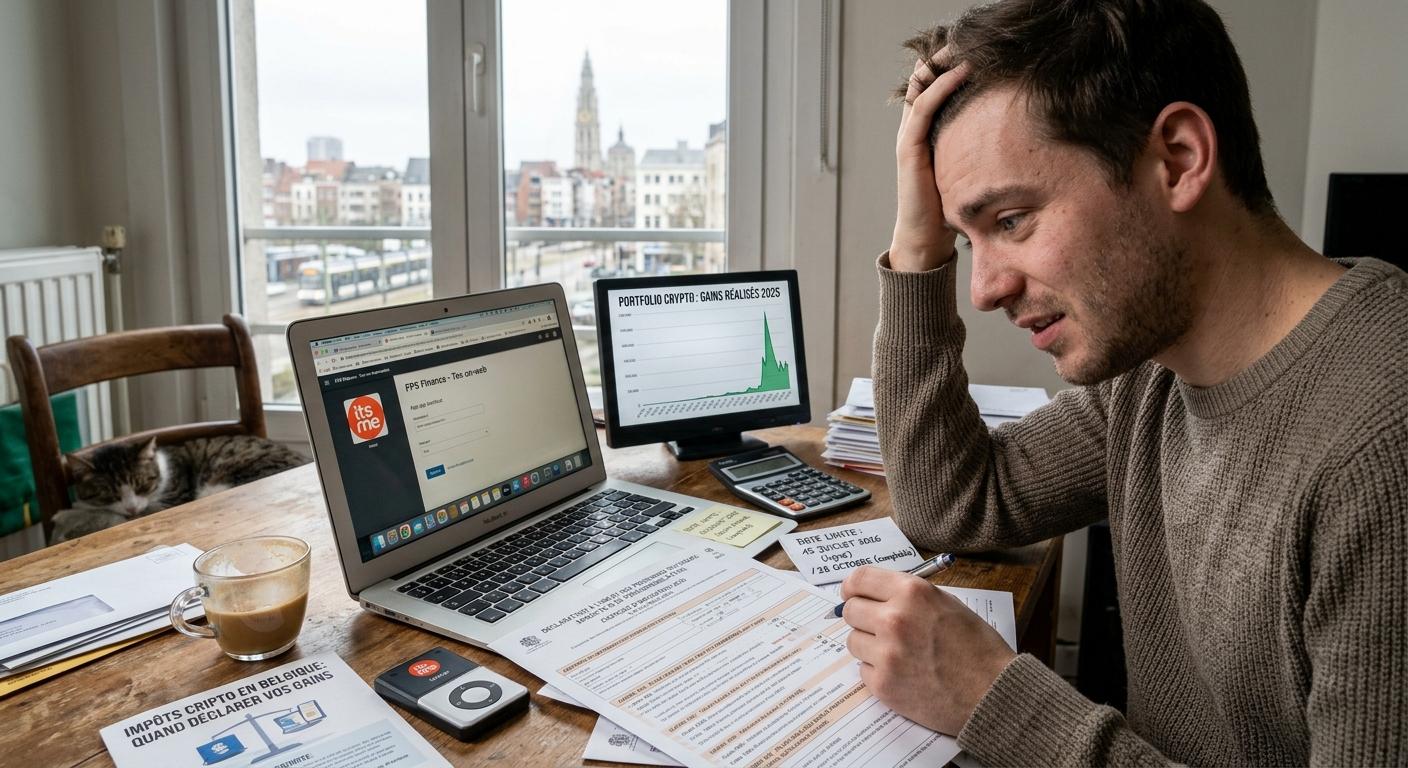
Crypto taxes in Belgium: when to declare your gains to the Belgian tax office
Published on Financiux.eu, clear finances for those who live and invest in Belgium.
For years, Belgium was a small paradise for crypto investors: as long as you behaved like a prudent investor, your gains weren't taxed. That era ended on 1 January 2026. And almost at the same time, exchanges began reporting their clients' information to European tax authorities.
It's a powerful combination: a new tax and a tax office that can now see a lot more. The question thousands of residents are asking is no longer "do I pay tax on my crypto?" but "when do I have to declare, and what exactly?". In this Financiux.eu guide we break it down step by step.
Quick answer: when you have to declare
These are the most common scenarios and what happens in each, based on the Belgian tax sources consulted as of October 2026:
| Situation | Do you have to declare? | Applicable regime |
|---|---|---|
| You buy and hold crypto without selling | No gain to declare | Not taxed until realised |
| You sell at a gain (normal management of private wealth) | Yes, from 2026 | 10%, with an annual €10,000 exemption |
| You sell at a gain and the administration sees it as speculation | Yes | 33% (miscellaneous income) |
| You trade professionally | Yes | Progressive rates, up to 50% |
| You earn staking, lending or DeFi returns | Yes | 30% (movable income) |
| You open an account on a foreign platform | Yes, with the PCC and in your annual return | Reporting obligation |
| You've only made losses | No taxable base | No tax |
| You move crypto between your own wallets | Not a sale | No tax in itself |
This table is a general guide. Classifying your specific case may require tax advice.
The three profiles: the "good family father" hasn't disappeared
The 2026 reform doesn't completely erase the previous system. According to tax analyses, the three types of behaviour still exist: normal management of private wealth, speculative activity and professional activity. What changes is how the first one is treated. If you want to understand where the concept comes from, we explain it in our article on the good family father myth.
- Normal management: gains used to be exempt. From 2026 they're taxed at 10%, with an annual exemption.
- Speculation: if the administration considers your activity goes beyond prudent management, gains may be taxed as miscellaneous income at 33%.
- Professional activity: if you operate as an economic activity, income is taxed at progressive income tax rates, which can reach 50%.
The practical problem is that there are no clear-cut legal criteria to distinguish between them. Factors such as trading frequency, use of leverage, the share of crypto in your wealth or the intention to make quick profits all influence the assessment. When in doubt, consult an adviser.
The new 10% rate applied to crypto
Crypto-assets fall within the definition of "financial assets" in the new law, which was passed in April 2026 with retroactive effect from 1 January. The key points, which we covered in the guide on capital gains tax in Belgium, are:
- 10% rate on realised gains.
- Annual exemption of €10,000 per taxpayer, indexable, with the option to carry forward unused amounts up to €15,000.
- Gains before 2026 are exempt. For assets acquired earlier, the starting value is that of 31 December 2025.
- FIFO for partial sales of identical assets.
- The year's losses can be offset against gains.
The crypto-specific problem: nobody withholds the tax for you
With a share, your Belgian bank can withhold the 10% at source. With crypto, you'll usually be trading on foreign platforms, and analyses point out that investors will have to declare their gains themselves. That means calculating every transaction, applying FIFO, documenting the value at 31 December 2025 and reporting the result in your tax return.
Your first return under the new rate will be the one for 2026 income, i.e. the 2027 return. But the calculations are based on this year's transactions, so it's worth starting now.
When is a gain considered "realised"?
Selling for euros is the obvious case. But advisers warn that crypto-to-crypto swaps and paying for goods or services in crypto can also count as realising a gain. It's a grey area that demands traceability of every transaction and acquisition cost. If you swap frequently, check with a professional.
Staking, lending and DeFi: capital income at 30%
Passive returns follow a different logic. Tax analyses agree that income from staking, farming, lending and other DeFi returns is generally treated as movable income and taxed at 30%, outside the 10% capital gains perimeter.
An example: if you receive €1,000 in ETH staking rewards, the tax is roughly €300.
According to standard tax guidance, this income is declared in box VII of the return, under code 1444 / 2444, the same one we use for [foreign dividends in Tax-on-Web](https://financiux.eu/blog/ foreign-dividends-belgium-tax-on-web), with section F to detail the country and nature of the income. The classification of certain DeFi flows remains debatable, so document the origin of each income stream carefully.
Your accounts on foreign platforms: PCC and annual return
Here's the obligation most often overlooked. An account on a foreign exchange is treated like a foreign bank account. That means two steps, the same ones we explain in the expat guide:
- Report it to the Central Contact Point (PCC) of the National Bank of Belgium.
- Mention it every year in box XIII of your income tax return.
Declaring gains without having reported the account to the PCC is an infringement separate from the taxation of the income. If you're already in that situation, the way to regularise is to declare the account retroactively and check that your previous returns are consistent.
DAC8: why the Belgian tax office will know what you're up to
For years the argument was simple: "the tax office can't see my account on a foreign exchange". That's no longer true. The European DAC8 directive, transposed into Belgian law by a March 2026 act, requires crypto-asset service providers to report information on transactions and user identities to tax authorities. The general framework for administrative cooperation is published by the European Commission.
According to analyses, reporting applies to transactions after 1 January 2026. In practice, this means the Belgian administration will be able to cross-check what platforms report against what you declare.
What about self-custody wallets?
Non-custodial wallets, i.e. those you control with your own keys, aren't directly covered by DAC8. But transfers from a platform to an external wallet are reported by the service provider to the SPF Finance, which leaves a trail of funds leaving. Some analyses suggest that, as things stand, holding your own wallet doesn't in itself require reporting it to the PCC, though this area is evolving. Check the current rules.
How to declare your crypto, step by step
- Gather the full history from each platform: buys, sells, swaps, transfers and rewards.
- Determine the value at 31 December 2025 of assets bought earlier. Keep screenshots and price quotes from that date as evidence.
- Calculate the year's gains using FIFO, subtracting acquisition costs and realised losses.
- Separate passive income (staking, lending) from gains on sale.
- Report your foreign accounts to the PCC if you haven't already.
- File your return on MyMinfin: gains in the section the SPF Finance opens for the new tax, passive income in box VII (code 1444/2444), and your accounts in box XIII.
- Claim the €10,000 exemption and declare all gains, since it isn't applied automatically.
- Keep all documentation for several years.
Always check the official instructions for each filing season at the SPF Finance.
A worked example
Elena bought 0.5 BTC in 2022. At 31 December 2025, that position was worth €30,000. In 2026 she sells it for €38,000.
- Taxable gain: €38,000 − €30,000 = €8,000 (the increase before 2026 is exempt).
- Tax: since it's below the €10,000 exemption, she pays €0, but she must declare the transaction and claim the exemption.
If she'd sold for €46,000, the gain would be €16,000. After the exemption, €6,000 would be taxed, i.e. €600.
On top of that, in 2026 Elena receives €1,000 from staking: 30% = €300, declared separately as movable income. The figures are illustrative and simplified.
What records you should keep
Traceability is your best defence. Keep:
- Statements from each exchange, downloaded regularly, because some platforms limit their history.
- Dates, amounts and prices of every buy, sell and swap.
- The value of each asset at 31 December 2025.
- Transfer records between platforms and your own wallets.
- Proof of your PCC reports.
If you also invest in crypto-linked exchange-traded products, such as bitcoin ETNs, bear in mind that the TOB applies to these products, at a rate of 0.12% for ETNs. To estimate it, use the Financiux.eu TOB calculator.
Common mistakes
- Thinking "if I don't cash out to euros there's no tax". Crypto-to-crypto swaps can be taxable events.
- Forgetting the foreign exchange account. It must be reported to the PCC and mentioned in your return.
- Confusing staking with capital gains. They follow different regimes: 30% versus 10%.
- Not documenting the value at 31 December 2025. Without it, your calculation basis is open to challenge.
- Assuming DAC8 doesn't affect you because you use international platforms. Providers report information to the authorities.
- Leaving it to the last day. Reconstructing a long history in a rush leads to errors.
What happens if you don't declare?
Omitting crypto gains or income can lead to a regularisation with the tax due, surcharges and tax penalties. And failing to declare your foreign accounts is an additional infringement. Review periods can be extended in cases of non-compliance. If you've traded in previous years without declaring, regularising is always better than waiting; consult a specialised tax adviser. This content is informational and doesn't replace personalised advice.
Frequently asked questions
Is there a tax on cryptocurrencies in Belgium?
Yes. Since 1 January 2026, crypto gains from normal management of private wealth are taxed at 10%, with an annual €10,000 exemption. Passive returns such as staking are taxed at 30%.
Do I have to declare if I haven't sold my crypto?
There's no gain to declare until you realise one, but you're still required to report your accounts on foreign platforms to the PCC and mention them in your annual return.
When do I declare my 2026 gains?
In the income tax return for 2026 income, which is filed in 2027. Prepare your calculations using this year's transactions.
What if my gains are under €10,000?
You pay no tax, but you must claim the exemption and declare your gains. It isn't applied automatically.
Is staking taxed the same as selling bitcoin?
No. Staking and other passive returns are treated as movable income and taxed at 30%, while the gain on a sale is taxed at 10% if it comes from normal management.
Can the Belgian tax office see my account on a foreign exchange?
Under DAC8, crypto-asset service providers report information on transactions and user identities to tax authorities. On top of that, your account must be reported to the PCC.
Does a self-custody wallet have to be declared?
According to the analyses consulted, non-custodial wallets aren't directly covered by DAC8 and don't in themselves require reporting to the PCC. The rules may change, so verify.
Conclusion: declaring properly is easier than reconstructing later
Crypto is no longer uncharted tax territory in Belgium. There's a new tax, a separate regime for passive returns, account reporting obligations and automatic information exchange. The good news is that it can all be managed with order: up-to-date records, reported accounts and calculations prepared before the return.
Start today with the most urgent: keep your history and report your foreign accounts. And for the rest of your portfolio, estimate the TOB on your transactions with the Financiux.eu calculator. If you want to keep learning how to invest clearly from Belgium, explore the rest of the guides on Financiux.eu.