
Declaring foreign accounts in Belgium: expat guide
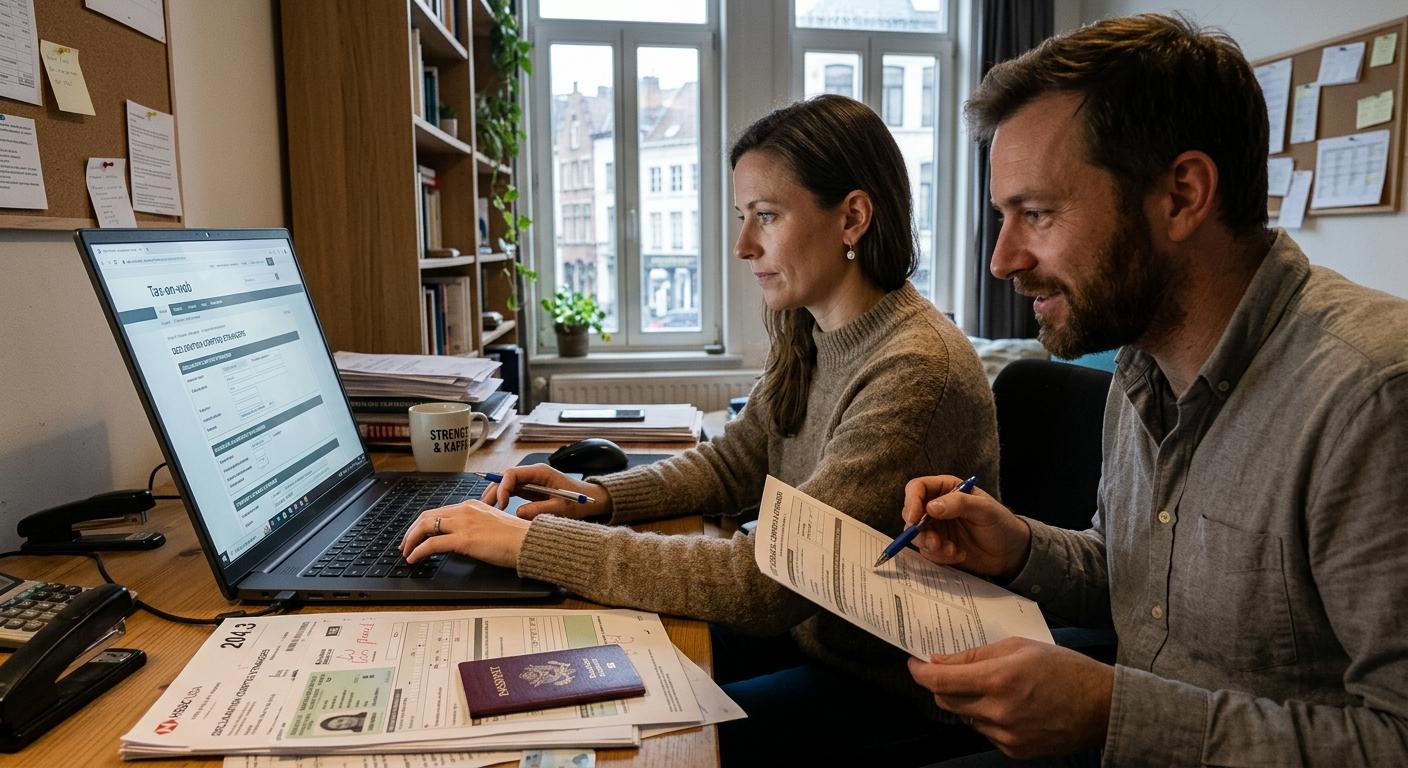
A guide for expats: how to declare your foreign bank and investment accounts in Belgium
Published on Financiux.eu, clear finances for those who live and invest in Belgium.
You move to Brussels, Antwerp or Leuven for work. You leave behind your flat, your friends and a bank account in your home country that you still use to pay insurance, receive transfers from family or hold your savings. You also open an account in Belgium, and maybe an online investment platform. Everything seems in order. But there's an obligation almost nobody tells you about when you arrive: the accounts you hold outside Belgium must be reported to the Belgian authorities, and your bank won't do it for you.
This Financiux.eu guide explains what you have to declare, to whom, when and how, with the concrete steps and the most common mistakes among those arriving from abroad.
Who has to declare foreign accounts?
The obligation falls on anyone who is a tax resident in Belgium. Broadly speaking, you are one if your domicile or the centre of your economic interests is in the country, for example because you've registered at your commune and live here permanently. Residents are taxed on their worldwide income, and that includes the assets and returns you hold abroad.
The legal basis is Article 307 of the 1992 Income Tax Code (CIR 92). It establishes a double transparency requirement: you must list your foreign accounts each year in your personal income tax return and, no later than when you file it, also report them to the Central Contact Point (CCP) of the National Bank of Belgium.
If you're unsure about your tax residence, for example because you've just moved or because you split the year between two countries, check the official FPS Finance pages and, if needed, a tax adviser. A double tax treaty may change the outcome in specific cases.
Which accounts you need to declare
The obligation is broad. It covers accounts of which you are a holder, joint holder or authorised representative:
- Current and savings accounts at banks in other countries.
- Securities accounts (shares, funds, ETFs, bonds), including those at foreign online brokers.
- Crypto-asset accounts opened on platforms outside Belgium. Although the rules are still evolving, the prudent approach is to declare them.
- Neobank accounts with a foreign IBAN.
Two important clarifications. First, simply holding the account is enough: it doesn't matter that you barely use it or that the balance is low. Second, digital payment accounts with no link to a professional activity, such as PayPal, are usually excluded, but it's worth confirming your specific case.
If you trade with a foreign broker like the ones we compare in DEGIRO vs Trade Republic in Belgium, that securities account is a foreign account in every sense. Declaring it is separate from whether the broker withholds the TOB or not.
The two declarations: CCP and annual return
Here's the point that confuses almost everyone: they're two separate procedures, and you have to do both.
Step 1: report the account to the Central Contact Point (NBB)
The CCP is a database managed by the National Bank of Belgium. Belgian banks automatically report their clients' accounts to it, but foreign banks don't. That's why reporting foreign accounts is up to you.
You do it online with your electronic ID card (eID) or with itsme, or by post using the official form. The NBB doesn't accept submissions by email. At a minimum you'll need the account number (IBAN), the name of the institution and the country where it was opened.
The deadline is this: the report must be made no later than when you file your income tax return for the year in which the account was opened. In practice, if you open an account in 2026, you report it to the CCP before filing your return for that year in 2027. Always keep the confirmation PDF as proof.
Once the initial report is made, you don't need to repeat it every year, unless something changes, such as a closure or a change of details.
Step 2: mention the account every year in your tax return
The second procedure is annual and isn't covered by the first. In the income tax return (PIT) there's a specific section, Box XIII, section A, where you indicate whether you have foreign accounts. That box also groups other situations: foreign life insurance (section B) and legal constructions such as trusts or foundations (section C).
Two practical warnings:
- If the administration sends you a simplified or pre-filled return, check it. It doesn't always include your foreign accounts, and correcting it is your responsibility before submitting.
- You file your return through MyMinfin, the official FPS Finance portal, with eID or itsme.
Account changes and closures
Closing an account doesn't release you from the procedure for that year. You must report the closure as a change to the CCP and keep mentioning the account in the return for the tax year in which it was open.
Step-by-step guide for newly arrived expats
- Take stock. List all your accounts outside Belgium: banks, brokers, neobanks and crypto platforms. Note the IBAN, institution, country and whether you're a holder, joint holder or authorised representative.
- Confirm your tax residence. Check whether you're already a resident in Belgium and since when. If you arrived mid-year, this affects what you declare.
- Report each account to the CCP. Go to the NBB website with eID or itsme and register each one. Download the confirmation PDF.
- Review your accounts before filing your tax return. Check whether you opened or closed any during the year.
- Tick Box XIII, section A in MyMinfin and make sure no pre-set box contradicts your situation.
- Declare the returns. Interest, dividends and other income from those accounts may be subject to tax in Belgium, depending on their nature.
- Keep all the paperwork for several years: CCP confirmations, statements and receipts.
What else to keep in mind with a foreign investment account
Declaring the account is only part of it. If you invest from abroad, there are other obligations that may apply to you:
The TOB. If your foreign broker doesn't withhold it, the calculation, declaration and payment are up to you, with deadlines and late-payment fines. We explain it in our guide on what the TOB is in Belgium and in the article on fines for paying the TOB late. To estimate how much you owe, you can use the Financiux.eu TOB calculator.
Taxes on dividends and interest. Foreign brokers usually don't withhold the Belgian withholding tax on movable property, so declaring that income is up to you.
The securities accounts tax (TCT). It targets large estates, from a threshold of one million euros in average value. If your situation is close to that level, check the current rate and conditions on the FPS Finance website.
Capital gains tax. Belgium has introduced taxation on certain financial capital gains, with exemptions and conditions. The rules keep changing, so always check the current legislation.
Why the Belgian authorities can see your accounts
It's tempting to think an account in another country is invisible. It isn't. There's automatic exchange of financial information between tax administrations in around a hundred jurisdictions, based on the OECD common standard (you can check the general framework on the OECD automatic exchange page). Your foreign bank may report balances and income to the authorities of your country of residence, and Belgium receives that information.
What happens then is simple: if the data reaching the tax office doesn't match what you declare, there's a discrepancy, and discrepancies get investigated.
Common expat mistakes
- Thinking your home-country account "doesn't count". It does, even if you barely use it.
- Doing only one of the two procedures. The CCP and the annual return are separate obligations.
- Trusting the simplified return. It may leave out your foreign accounts.
- Forgetting accounts where you're only an authorised representative or joint holder.
- Not updating after a closure. Closing the account doesn't remove the obligation for that tax year.
- Assuming the broker takes care of everything. Withholding the TOB doesn't replace reporting to the CCP.
- Waiting until the last minute. Reconstructing balances and opening dates in a rush leads to mistakes.
What happens if you don't declare your foreign accounts?
Not reporting your accounts or not mentioning them in your return can lead to administrative and tax penalties. On top of that, non-compliance can extend the periods during which the administration can review your tax years, lengthening the period at risk. The exact amounts and conditions depend on each case, so check them with the FPS Finance or an adviser.
If you realise you've left out an account, the recommended approach is to regularise as soon as possible: report the account to the CCP, correct your situation in the next return and consult a professional if the case spans several years. This content is for information only and doesn't replace personalised tax advice.
Frequently asked questions
Do I have to declare a foreign account if the balance is small?
Yes. The obligation is triggered by being a holder or authorised representative of the account, regardless of the balance or how much you use it.
When do I have to report a new account to the National Bank of Belgium?
No later than when you file the income tax return for the year in which you opened the account. It's best to do it as soon as you open it so you don't forget.
Do I have to repeat the CCP report every year?
No. The initial report is enough, unless there are changes or closures. What does repeat every year is the mention in your tax return (Box XIII, section A).
How do you declare a broker account like DEGIRO or Trade Republic?
Like any foreign account: to the CCP and in Box XIII of your annual return. Separately, check whether the broker withholds the TOB or whether you have to handle it yourself.
Do cryptocurrency accounts have to be declared?
The rules are still evolving, but the prudent recommendation is to declare crypto-asset accounts opened on foreign platforms.
Can I do it myself or do I need an adviser?
For simple situations with few accounts, you can do it yourself via the NBB portal and MyMinfin. If you have many accounts, several countries involved or doubts about your residence, a tax adviser is worth it.
Conclusion: transparency now, peace of mind later
When you arrive in a new country, there are a thousand urgent procedures and this one usually ends up at the bottom of the list. But it's one of the ones most worth doing early: it's a few minutes with your eID, a box ticked each year and the peace of mind of not having a hidden risk in your tax situation.
Take stock, report each account to the CCP, check Box XIII and, if you invest through foreign platforms, estimate your TOB with the Financiux.eu calculator. And to keep learning how to invest clearly from Belgium, explore the rest of the guides on Financiux.eu.