
Accumulating vs Distributing ETFs in Belgium: Pay Less TOB
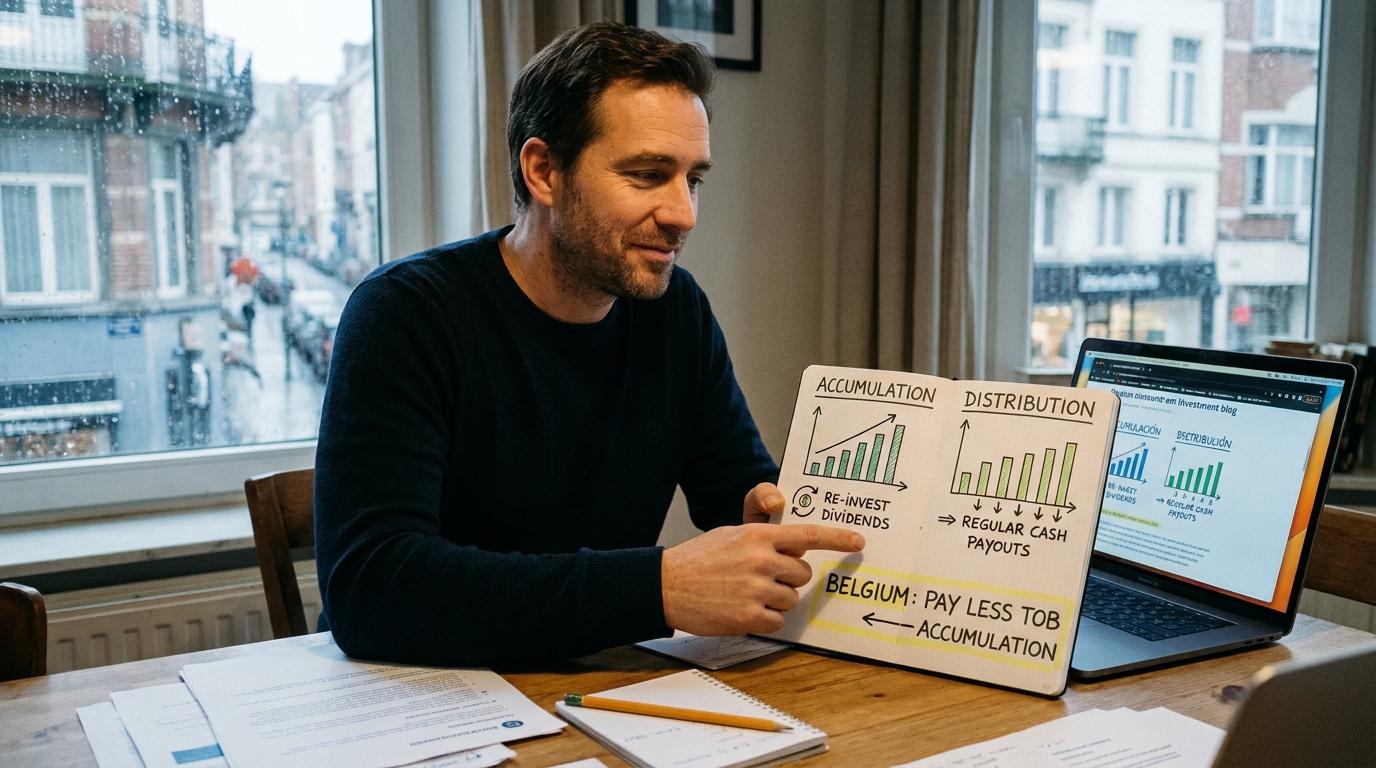
Accumulating vs distributing ETFs in Belgium: the legal strategy to pay less TOB
Published on Financiux.eu, clear finance for those who live and invest in Belgium.
Picture two investors who buy exactly the same amount of two ETFs tracking the same index. One pays 12 euros in stock exchange tax. The other pays 132. There's no trick, no accounting error: it's the Belgian TOB doing what it does best, which is complicating something that looked simple.
The difference, eleven times bigger, doesn't depend on returns or the index. It depends on two details almost nobody checks before buying: whether the ETF pays out dividends or reinvests them and where it's registered. In this Financiux.eu guide we explain how it works, how to check it in five minutes and how to choose, entirely legally, the ETF that costs you the least TOB.
A nuance that changes everything: accumulating doesn't mean 1.32%
It's very common to read that "accumulating ETFs pay 1.32% TOB". That's half the truth, and understanding the missing half is precisely where the savings are.
The TOB that applies to a listed ETF depends on three factors, according to information from Belgian consumer associations and tax specialists:
- Where the ETF is registered: inside or outside the European Economic Area (EEA).
- Whether it's also registered in Belgium.
- Whether it distributes dividends or accumulates them.
Most ETFs you can buy from Belgium are registered in the EEA, but not specifically in Belgium. For those, the TOB is the lowest: 0.12%. And this applies to both distributing and accumulating versions.
The TOB rules for ETFs, in short
| ETF situation | Distributing | Accumulating | Cap per transaction |
|---|---|---|---|
| Registered in the EEA, not in Belgium | 0.12% | 0.12% | €1,300 |
| Registered in the EEA and in Belgium | 0.12% | 1.32% | €1,300 / €4,000 |
| Not registered in the EEA | 0.35% | 0.35% | €1,600 |
A few extra points worth keeping in mind:
- The TOB on listed ETFs is paid both when you buy and when you sell.
- It's calculated on the transaction amount, not on the broker's commissions. If you buy €1,000 of an ETF at 1.32% and the broker charges you a €15 commission, the TOB is €13.20.
- ETCs (commodities and currencies) are taxed at 0.35%, and ETNs at 0.12%.
- Unlisted funds work differently: they only pay TOB, 1.32%, when you sell units in accumulating funds, and nothing in all other cases.
The top rate, 1.32%, is aimed at accumulating funds included on the FSMA list. Even so, according to information published by Belgian financial institutions, it has a cap of €4,000 per transaction, and the 0.12% rate has a cap of €1,300.
Why the same ETF can have different rates depending on registration
There's a tax reason behind this rule: Belgium applies the highest rate to accumulating funds registered on its territory, because in that case the tax authority doesn't collect periodic taxes on reinvested dividends. The TOB works, in part, as compensation. It's a curious mechanism, because ETFs registered in Belgium end up paying a higher TOB than the rest.
The share class trap
ETFs often have several versions: one that pays out dividends, another that accumulates them, one in euros, another in dollars. Here's the most dangerous detail: if any of those versions is registered in Belgium, the tax authority considers them all to be.
A concrete case: if a fund's distributing share class is registered in Belgium but its accumulating one isn't, the latter is taxed as if it were registered. That is, at 1.32%. That's why you should look at the specific ETF, with its ISIN code, and not just the index or the issuer.
But the TOB isn't the only tax at stake
Choosing based on TOB alone would be a mistake. The accumulating-versus-distributing decision affects other Belgian taxes:
- Dividends (distributing): the dividends paid out by a distributing ETF are taxed at 30%. And according to SPF Finances, dividends obtained through funds fall outside the €833 exemption. If your broker is foreign, you also have to declare them yourself, as we explain in our guide on foreign dividends in Tax-on-Web.
- Capital gains (accumulating and distributing): from 2026 there's a 10% tax on capital gains from financial assets, with an annual exemption of €10,000. We explain it in the article on the capital gains tax in Belgium.
- Reynders tax: if the fund invests a significant share in fixed income, a specific 30% tax may apply to the corresponding part of the capital gain.
In other words: the accumulating ETF defers the tax until you sell, while the distributing one takes it every time you receive a dividend.
A side-by-side example
Let's look at three scenarios with a €10,000 investment held for ten years and sold for €18,000. It's an illustrative, simplified example: it assumes an annual dividend of 1.8% on an average value of €14,000 and doesn't take dividend reinvestment into account.
| Scenario | TOB (buy + sell) | Dividend tax | Capital gains tax | Approx. total tax cost |
|---|---|---|---|---|
| A. Accumulating, registered in the EEA (not Belgium) | €12 + €21.60 = €33.60 | €0 | €0 (below the exemption) | ≈ €34 |
| B. Accumulating, registered in Belgium | €132 + €237.60 = €369.60 | €0 | €0 | ≈ €370 |
| C. Distributing, registered in the EEA | €33.60 | ≈ €756 | €0 | ≈ €790 |
What the table shows is striking: the accumulating ETF not registered in Belgium wins hands down. But look at scenario C: even though the TOB is low, the 30% dividend tax becomes the biggest cost. So the strategy isn't just "pick the lowest TOB rate", it's about choosing the product with the lowest total tax cost.
If your portfolio gets close to the €10,000 annual capital gains exemption, the numbers change. If your ETF holds fixed income, the Reynders tax may come into play. And whether your broker withholds or not changes the admin work, not the tax.
How to check your ETF's TOB rate, step by step
Before you buy, spend five minutes on these checks:
- Identify the exact ETF by its ISIN. The fund name isn't enough: each version, distributing or accumulating, and each currency has its own code.
- Confirm whether it's registered in the EEA. Most ETFs you can buy from Belgium are, usually in countries like Ireland or Luxembourg. You can check the European fund register on the ESMA website.
- Check whether any share class appears on the FSMA list. The FSMA, Belgium's financial regulator, publishes the list of foreign funds registered in Belgium. If any version of the fund appears there, the "registered in Belgium" rate applies to all of them.
- Check whether it's distributing or accumulating. The product sheet or the key information document (KID) tells you.
- Cross-check against your broker's statement. Compare the rate they apply with the one you expected.
This last check is more important than it looks. In practice, consumers have found that the standard 0.12% rate is sometimes replaced by 0.35%, or even 1.32%, on statements. Review your statements regularly: if you're overcharged, ask your institution for a correction.
The legal strategy to pay less TOB
Now for the practical guidelines. All of them are legal: this isn't about evading taxes, but about choosing, among equivalent products, the one with the least tax friction.
1. Favour ETFs registered in the EEA and not in Belgium. It's the golden rule: the rate is 0.12%, even if the ETF is accumulating.
2. If two ETFs track the same index, compare their TOB rate. There's often an equivalent alternative from another issuer that avoids the 1.32%. An ETF registered in Belgium is only worth it if there's no comparable substitute in cost and quality.
3. Check the share class, not just the fund. If one version of the ETF appears on the FSMA list, the whole family may be affected.
4. Weigh the total tax cost, not just the TOB. A distributing ETF with a low TOB can end up costing more than an accumulating one because of the dividend tax.
5. Cut down on the number of transactions. The TOB is paid on every buy and every sell. Batching contributions, as long as it fits your strategy, saves TOB and admin work.
6. If your foreign broker doesn't withhold the TOB, always calculate the correct rate. With the Financiux.eu TOB calculator you can estimate the amount before declaring.
When a distributing ETF does make sense
Accumulating isn't a universal recipe. A distributing ETF may suit you if:
- You need regular income from your portfolio.
- You want to avoid building up a large capital gain that exceeds the annual exemption.
- The equivalent accumulating ETF is registered in Belgium and you can't find an alternative, which pushes the TOB up to 1.32%.
The key is to decide with numbers, not gut feeling.
Common mistakes
- Assuming accumulating means 1.32%. Only if the ETF is registered in Belgium.
- Looking only at the ETF name and not the ISIN. Each version has its own treatment.
- Ignoring the FSMA list. It's the point where the applicable rate is decided.
- Not reviewing your broker's statement. There can be errors in the rate applied.
- Comparing only the TOB and forgetting the dividend tax. Total cost is what counts.
- Not keeping your information up to date. The lists of registered funds change over time, so an old check can go stale.
What happens if you apply the wrong rate?
If your broker doesn't withhold the TOB and you calculate it at the wrong rate, you may pay too little, with the risk of a reassessment and penalties, or too much. Late filings and errors have consequences we detail in our article on penalties for paying the TOB late. And if you need a refresher on how to file, there's the guide to filling in the TOB form step by step. If the amounts are large, consult a tax adviser. This content is informative and doesn't replace personalised advice.
A reform on the horizon
There's been talk of reforming the TOB, and until the rules change, the current system still applies. Always check the current information on the official SPF Finances TOB page before making important decisions.
FAQ
Do accumulating ETFs always pay 1.32% TOB?
No. The 1.32% applies to accumulating ETFs registered in Belgium. ETFs registered in the EEA but not in Belgium pay 0.12%, whether accumulating or distributing.
How do I know if my ETF is registered in Belgium?
Check the list of foreign funds registered in Belgium published by the FSMA. If any share class of the fund appears on it, the tax authority considers them all to be.
What TOB do distributing ETFs pay?
0.12% if they're registered in the EEA, with or without registration in Belgium. If they're not registered in the EEA, the rate is 0.35%.
Is the TOB paid when buying and when selling an ETF?
Yes, for listed ETFs it's paid both when you buy and when you sell.
Is an accumulating or a distributing ETF better in Belgium?
It depends on your situation. Accumulating avoids the 30% dividend tax and defers taxation until you sell, but it's best if the ETF isn't registered in Belgium, so you don't pay the 1.32% TOB. Always compare the total tax cost.
Do ETF dividends count towards the €833 exemption?
According to SPF Finances, dividends obtained through funds are excluded from that exemption.
Conclusion: picking the right ETF matters more than saving on commissions
Two almost identical ETFs can have very different tax costs in Belgium. The difference between 0.12% and 1.32% TOB is repeated on every buy and every sell, and it adds up over the years. Checking the ISIN, looking at the FSMA list and comparing the total tax cost are steps that take minutes and can save you hundreds of euros.
Before you buy, run the check. And when it's time to calculate, estimate your TOB with the Financiux.eu calculator. To keep discovering how to invest with clarity from Belgium, explore the rest of the guides on Financiux.eu.